


How Is Electroformed Jewellery Made by Hand?
A fallen oak leaf is fragile enough to crumble between your fingers. Yet, given patience, copper, and a little alchemy, it can become a pendant made to accompany you for years. So, how is electroformed jewellery made? It is a slow process of building real natural forms into metal, one microscopic layer at a time.
Unlike a factory-cast charm, electroformed jewellery begins with an object that has already lived a life in the wild: a curled leaf, a slender twig, a tiny shell, or a stone with its own secret landscape. No two beginnings are identical. That is why no two finished pieces are either.
How electroformed jewellery is made, step by step
Electroforming uses an electric current to draw metal from a liquid solution on to a prepared surface. In a sacred jewellery atelier, that science becomes a deeply hands-on craft. The process asks for steady attention at every stage, because the final piece remembers every vein in a leaf, every curve in a shell, every deliberate mark made by the artist’s hands.
It begins with respectful gathering
For botanical jewellery, the first act is not technical at all. It is noticing. A leaf may be gathered after it has fallen, selected for the strength of its stem, its visible veins, or the particular gesture it makes as it dries. A cypress sprig carries a different feeling from a ginkgo leaf; an oak leaf has its own copper-kissed character.
Not every natural find is suitable. The form must be dry, stable, and strong enough to withstand preparation. Very soft, damp, or brittle material can shift, crack, or break during the making process. This is one reason electroformed work is never truly repeatable: nature sets the terms.
The artist may also begin with a crystal, recycled metal component, or a hand-sculpted detail. Labradorite, obsidian, moss agate, and other stones can be paired with botanical forms to create a piece that feels both grounded and talismanic. The placement of each element is considered before any copper touches it.
The form is sealed and made conductive
A leaf is not metal, and electricity cannot plate directly on to it. First, it must be thoroughly dried and sealed. This helps protect the delicate organic material from the electroforming bath and gives the surface a stable foundation.
Once sealed, the chosen areas are coated with a conductive paint or powder, often containing fine graphite or copper. This dark coating is the bridge between the natural object and the metal that will grow over it. Areas intended to remain bare, such as the face of a crystal, are carefully masked and protected.
This stage requires a quiet kind of precision. Too little conductive coating can leave patchy areas where copper will not take. Too much can soften the finest leaf veins or obscure the small textures that made the found object worth preserving in the first place.
Copper grows in the electroforming bath
The prepared piece is attached to a wire and suspended in an electroforming bath, usually a copper-rich electrolyte solution. A copper anode sits in the bath as the source metal, while the jewellery piece becomes the cathode. When a low direct current passes through the solution, copper ions travel through the liquid and settle on the conductive surface.
They do not arrive as a solid shell all at once. Copper builds gradually, atom by atom, over many hours and sometimes longer. The maker watches the current, the temperature, the solution, and the surface of the growing piece. A change in any one of these can affect the finish.
Too much current can create rough, powdery deposits rather than a smooth, strong layer. Too little can make the process painfully slow or incomplete. The aim is not simply to cover the object in copper, but to create enough metal for a durable, wearable form while honouring its original texture.
This is where the magic people sense in electroformed jewellery has a very practical foundation. The copper is not glued on or pressed around the leaf. It is grown over it. Every ridge, vein, curl, and crevice becomes part of the metal skin.
The piece is refined by hand
When the copper has reached the desired thickness, the piece is removed from the bath, rinsed, and carefully cut free from its wire. It may then be shaped, strengthened, filed, burnished, or polished by hand. Edges are checked for comfort, bails are refined so a pendant hangs beautifully, and the back is given as much care as the front.
A maker can choose a bright polish that catches the light, a darker antiqued finish that draws out the botanical detail, or a more weathered surface with the feeling of an object unearthed from the forest floor. None is automatically better. A high shine suits some crystals and silhouettes; an aged patina can bring depth and stillness to others.
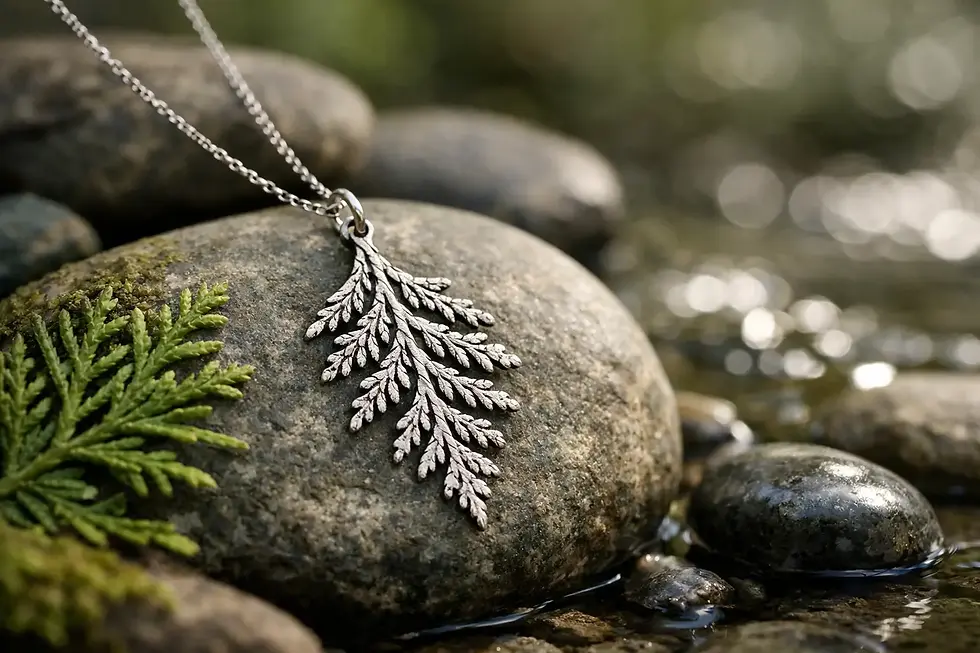
Some electroformed jewellery is then silver plated, usually over a strong copper foundation. Silver brings a cooler moonlit tone, while copper has an earthy warmth and changes gently with wear. The exact finish depends on the piece, the design, and the story it is being asked to hold.
Why real botanical electroforming feels different
A stamped leaf-shaped pendant can be lovely, but it begins as a design reproduced many times. An electroformed leaf begins as a particular leaf from a particular moment. Its asymmetry is not a flaw to be corrected. It is its signature.
That distinction matters if you are drawn to jewellery as a marker of memory, transition, or belonging. A real maple leaf can hold the feeling of a season turning. A small twig can become a reminder to bend without breaking. A shell may carry the hush of a shoreline long after the tide has moved on.
At Red Forrest Boutique, this relationship with the source material is central. The work is not about making nature look tidier or more fashionable. It is about preserving its wild detail and allowing it to remain visible against the skin.
Electroformed jewellery is made through chemistry, yes, but it is never only chemistry. It is a meeting of the wild and the deliberate: a leaf that once moved in the wind, copper that slowly gathered around it, and a pair of hands willing to wait. Perhaps the right word is ALCHEMY?
Wear Red Forrest jewellery as a small reminder that what is delicate can still endure.


Amazing